

Passing on His Legacy
April 23, 2026
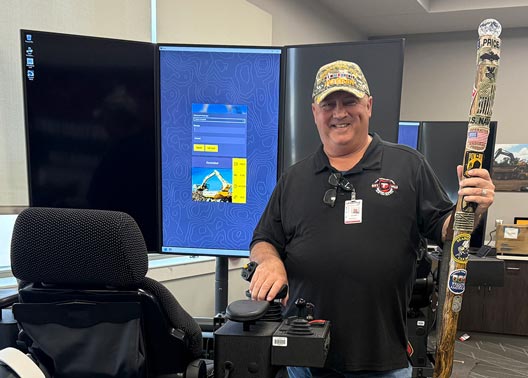
At 62, David Price still finds joy in getting his hands dirty, only now, he’s using that passion to shape the next generation of skilled workers.
His journey started in Texas, following in his father’s footsteps to Texas A&M’s Engineering Extension Service (TEEX), where he first learned the ins and outs of heavy equipment. That early foundation sparked a lifelong career, but it was his next step that tested those skills in the most demanding conditions.
Price joined the U.S. Navy and was an Equipment Operator, First Class. He operated dozers, excavators and motor graders in Afghanistan, often working around active minefields. Every movement required precision, and every machine required its own certification. As he built his qualifications, leadership took notice. Before long, he was not just operating equipment, he was training others to do the same.
When he returned to civilian life, Price brought that experience with him to a major infrastructure project, helping build the light rail system that runs through downtown Dallas. The work connected him to something bigger, building systems that communities rely on every day, and eventually led him back to TEEX, this time as an instructor. He traveled across Texas, training Texas Department of Transportation employees on how to safely and effectively operate heavy equipment.
Later, a career shift into the trucking industry introduced Price to Donnie Tulk, Tulsa Tech’s Professional Truck Driving Coordinator. That connection would open the door to his next chapter. In 2018, Price was recruited to Tulsa to serve as an embedded instructor at Becco Contractors, where he trained employees on heavy equipment and job site fundamentals.
Today, Price continues that work through his role with Tulsa Tech, splitting his time between Becco and the Client Service Center on the Lemley Memorial Campus. In 2025, he helped launch the first class of students from Nathan Hale High School, giving them early exposure to heavy highway equipment basics and the construction industry as a whole.
“I teach them everything from tape measures and saws to hammers and nails, as well as surveying equipment and site work,” Price said. “When they go to work in construction, they’ll understand the language and the environment. They’ve already got a year head start.”
His classroom blends hands-on learning with modern technology. Advanced simulators now replicate the feel of operating real machinery, giving students a safe and realistic training environment.
“Technology has advanced so much,” Price said. “You can run equipment remotely, just like drones in the military. That’s where this industry is headed.”
Still, Price emphasizes that success goes beyond technical skill. He reminds students daily that professionalism, honesty and self-motivation are what set them apart. “Life is a self-motivated game,” he said. “Everything matters.”
In his program, students focus on mastering three core machines, the dozer, excavator and backhoe. “Once you understand those, you can run just about anything,” Price explained, noting how those skills translate across the industry.
For Price, teaching is deeply personal. It’s a continuation of a legacy passed down through generations of his family.
“I haven’t worked a day since I started here,” he said. “I get to play in the dirt and teach people what my great-grandfather, grandfather and father taught me. I’m passing on a legacy.”
That sense of purpose carries into his life outside the classroom. In his spare time, Price crafts walking sticks, more than 100 in the past year alone, using reclaimed materials from antique stores. Each one is unique, inspired by his belief that “every good leader has a staff.” He plans on creating one for each person at the Client Service Center.
After decades of experience across Texas and beyond, Price says what he’s found in Tulsa stands apart.
“The level of professionalism, the investment in technology, the opportunities, I had no idea,” he said. “Tulsa Tech is doing something special.”
It’s a place he’s proud to call home, and one he has no plans to leave.
“I would stay here 50 to 100 years if I could,” Price said. “There’s nothing I’ve seen that compares.”